Idea Management Is About Scale
Why the real value of ideas comes from what you do after the first implementation

In a hurry? Here are the key insights:
The majority of individual ideas have marginal value — the real impact comes when ideas are scaled across the organization.
You can’t predict where great ideas will come from, so decentralization is essential.
The challenge is balancing broad participation with the ability to identify scalable ideas.
Clear guidance and strategic filtering enable fast implementation without losing sight of big opportunities.
Idea Management tools, powered by Generative AI, help organizations prioritize ideas with the most potential.
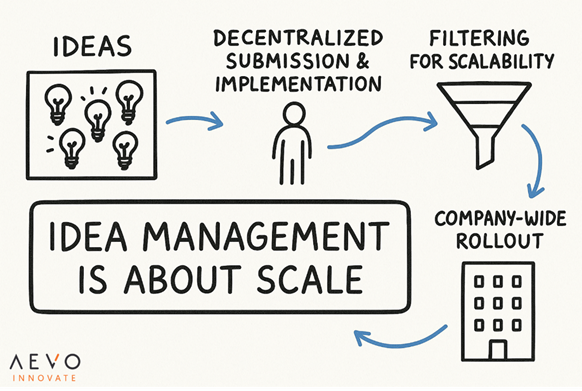
Idea management is often associated with operational excellence and incremental innovation. That’s why, in most organizations, the impact of most of the implemented ideas is marginal when looked at individually.
But the real value doesn’t lie in isolated wins. It’s unlocked when high-potential ideas are scaled across the organization.
Take the example of a utility company. An electrician in the field might design a tool that improves the maintenance process for utility poles. The gain in productivity for that one technician is small. But if hundreds of electricians across the company perform similar tasks, and the tool is deployed to all of them, the impact becomes substantial. That’s where idea management moves the needle.
This structured expansion process is commonly referred to as a rollout — moving an idea from a local implementation to a broader deployment across teams, units, or even countries.
However, here's the paradox: it’s impossible to predict where the best, most scalable ideas will come from. That’s why the most effective programs allow for maximum decentralization — giving every employee the opportunity to contribute.
The challenge, then, is this:
How do you decentralize idea implementation while still identifying those rare ideas worth scaling?
The solution lies in a well-structured process.
It starts with clear guidance: what kind of ideas is the organization looking for?
Ideas to reduce lean waste?
Ideas to cut work hours or operational steps?
Ideas to lower raw material costs?
You need to define what "moves the needle" in your context.
With this orientation in place, companies can encourage broad participation and local implementation without sacrificing strategic oversight.
The best organizations empower their innovation, continuous improvement, or operational excellence teams to act as filters — identifying ideas with scaling potential.
When such ideas emerge, these teams step in to provide support the frontline employee couldn’t access alone. Returning to the electrician example, this could mean helping prototype the tool using a 3D printer, refining it through structured iterations.
Once the value is validated, the rollout process begins. This often starts with a small expansion to other teams or regions, gathering more evidence of impact. If results are consistent, the solution can then become a formal operational standard.
One large energy distribution company follows this model. Their innovation team reviews all submitted ideas, identifies high-potential ones, supports their development, and pilots them in three different regions. If the value is confirmed at each stage, the solution is standardized and rolled out company-wide.
In practice, identifying ideas with high potential can be complex and even unfeasible without the right tools. That’s where using an idea management platform like AEVO Innovate becomes valuable. It helps organize the process from collection to rollout. In our case, we use Generative AI to assign a predictive score to each idea, based on its potential and the specific goals of each challenge (cost reduction, OEE improvement, etc.). This allows evaluators to focus first on the most promising ideas — already aligned with strategic priorities.
Idea management, done right, is not about collecting suggestions. It’s about creating a repeatable system that turns insights from the field into transformation at scale.