Measuring ROI in Idea Programs: What the Best Companies Do Differently
Practical insights from top performers on how to align idea programs with measurable business outcomes

In a time of expensive capital, innovation is under increasing pressure to deliver results quickly. That’s why idea programs are gaining traction. Typically tied to incremental innovation or operational excellence, they tend to generate visible short-term returns, especially when focused on rollout (I wrote more about that in Idea Management is About Scale).
At the beginning of 2025, we conducted a study with dozens of corporations using AEVO Innovate to manage their Idea Programs. Among the companies with the most mature ROI tracking practices, we identified a few key habits that set them apart:
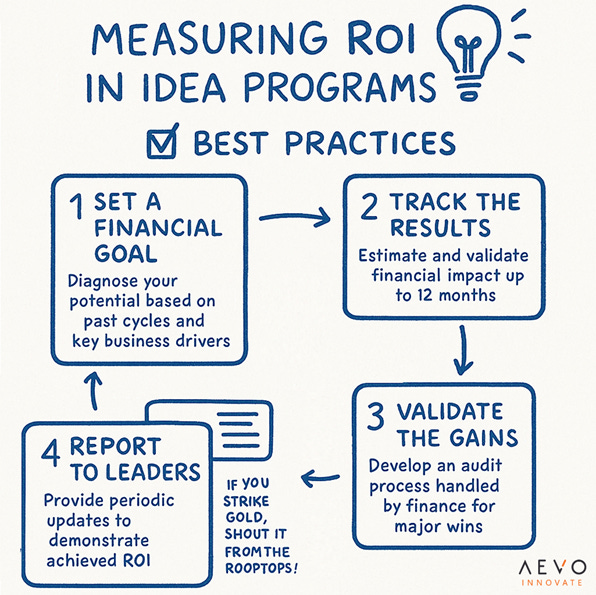
1- Set a financial ROI goal from the start
Start your program with a clear, realistic financial target. The goal should be based on a potential assessment, either from previous cycles or reasonable assumptions tied to what you aim to impact: typically cost savings, productivity gains, or cost avoidance. This aligns the program with business outcomes from day one.
2- Consistently estimate and measure results
Surprisingly, many programs don’t measure the impact of implemented ideas. The best ones do. They follow each idea’s impact for 12 months after implementation, or at least track results for 3 months and project forward. Of course, each idea will have a different economic logic (material savings, energy reduction, fewer labor hours, etc.), and the calculation must be tailored accordingly.
3- Validate what’s been achieved
Leading companies have structured validation processes for high-value ideas. This brings transparency and credibility to reported results. Finance or controlling teams are often involved in validating major savings, while lower-impact ideas are usually validated by the department responsible or the idea management team itself.
4- Regularly report results to leadership
One of the most common pitfalls is letting great results go unnoticed by leadership. It’s not enough to lay the egg, you have to cluck! The best programs report ROI consistently and clearly, comparing outcomes to investment. We’ve seen programs with a 10–20x return. With numbers like that, leadership buy-in only grows stronger.
Bonus: Don’t ignore non-financial results
Impact isn’t always about money. High-performing companies also track qualitative value: improvements in workplace safety, reduction in hours (even without cost reduction), increased product quality, or positive environmental outcomes. These KPIs should reflect what matters most to the organization.
Bottom line, measuring ROI isn’t something to leave for the end. Successful idea programs are designed with ROI in mind from the very beginning. The best companies treat idea programs as a strategic lever to improve performance. And when executed well, the return becomes impossible to ignore.
My favorite one, so far!!!! great piece of content. Kudos, Luis!